
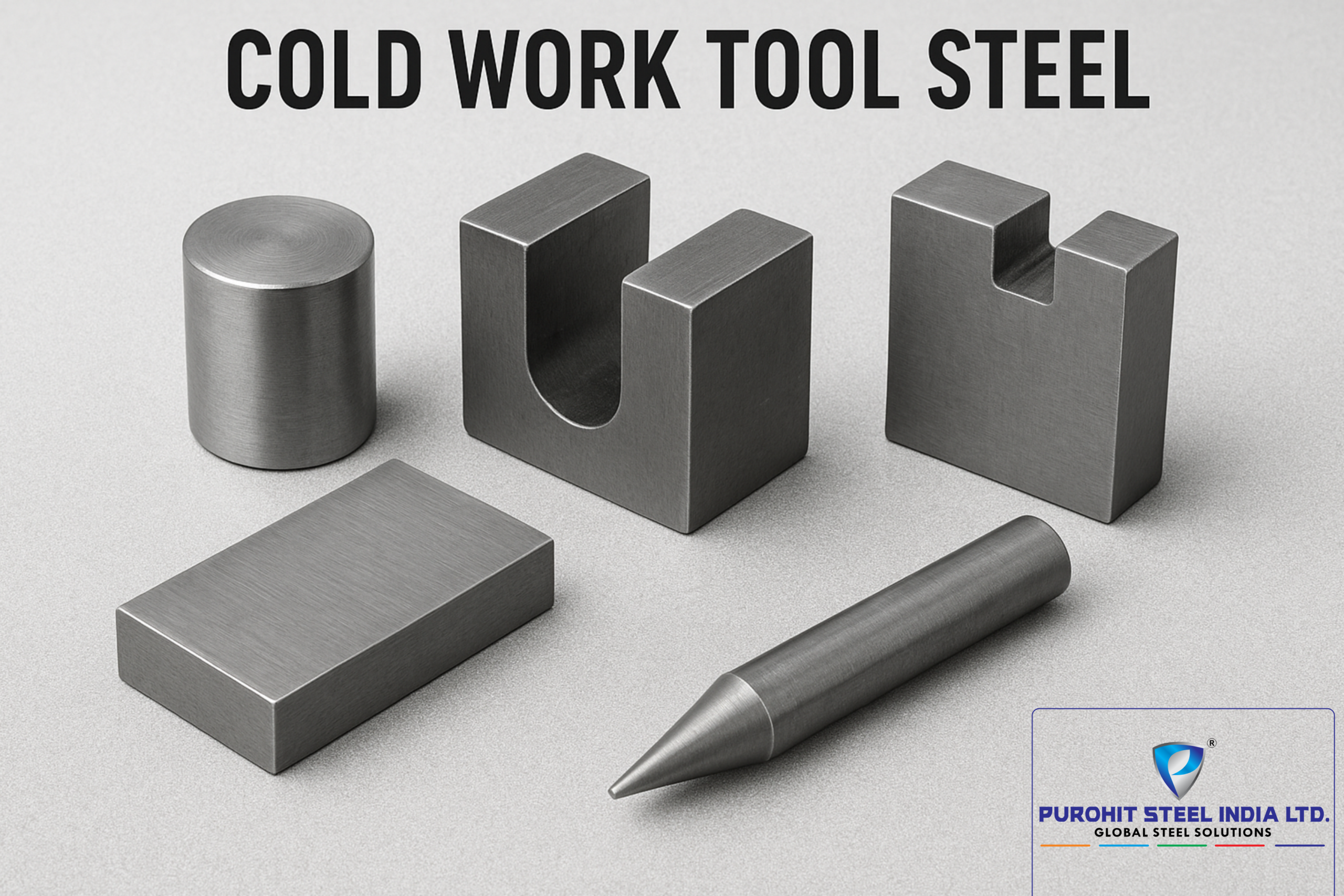
Cold Work Tool Steels
Cold Work Tool Steels are specially developed steels designed for tooling that operates at room temperature or slightly elevated temperatures (below 200°C). They are widely used for cutting, punching, forming, shearing, and shaping materials under cold conditions.
These steels offer a balance of:
1. High wear resistance
2. High hardness
3. Good toughness
4. Dimensional stability
5. Deep hardenability
Cold work tool steels are essential for high-precision tools used in sheet metal, automotive components, fasteners, dies, punches, and more.
Types of Cold Work Tool Steels
1. Oil-Hardening (O-Series) – Tough & economical
Typical grade:
a. O1 (1.2510)
b. O2 (1.2842)
Features:
a. Good toughness
b. Easy to machine
c. Low distortion after heat treatment
d. Suitable for general-purpose tooling
2. Air-Hardening (A-Series) – High dimensional stability
Typical grade:
a. A2 (1.2363)
Features:
a. High wear resistance
b. Excellent stability & low distortion
c. Good machinability
d. Suitable for precision tools
3. High-Carbon High-Chromium (D-Series) – Extreme wear resistance
Most popular cold work steels worldwide.
Typical grades:
a. D2 (1.2379)
b. D3 (1.2080)
Features:
a. Very high wear resistance
b. High hardness (up to 62 HRC)
c. Good abrasion resistance
d. Ideal for mass production and long tool life
Typical Applications of Cold Work Tool Steels
1. Punches & dies
2. Shear blades
3. Cold forging dies
4. Wire drawing dies
5. Rolling dies
6. Reamers, broaches & milling cutters
7. Guillotine knives
8. Forming tools
9. Master tools & gauges
Key Properties
1. High wear and abrasion resistance
2. High compressive strength
3. Ability to maintain hardness at room temperature
4. Good toughness (grade dependent)
5. High dimensional stability during heat treatment
6. Long service life in heavy-duty applications