
Purohit Steel is a leading Grade 1.2738 Stockist and Exporter in India, supplying premium pre-hardened P20+Ni (40CrMnNiMo8-6-4) plastic mould steel with verified chemical composition, mechanical properties and full traceability for mould makers, OEMs and tooling houses working with large mould blocks.
As an ISO-certified company established in 1965, we maintain ready stock of Grade 1.2738 in round bar, flat bar and block form, with in-house bandsaw cutting, machining, grinding and EDM support for fast turnaround across India and export markets.
Table of Contents
- 1. What is Grade 1.2738 Steel
- 2. Why Purohit Steel for 1.2738
- 3. Comparison: 1.2738 vs 1.2311 vs 1.2083 ESR
- 4. Chemical Composition
- 5. Mechanical Properties
- 6. Physical & Thermal Properties
- 7. Equivalent International Grades
- 8. Heat Treatment Guidelines
- 9. Available Forms & Sizes
- 10. Machining & Selection Notes
- 11. Applications & Uses
- 12. Industries We Serve
- 13. Related Products
- 14. Authorized Stockist Brands
- 15. Cities We Supply in India
- 16. Our Services
- 17. Frequently Asked Questions
- 18. About Purohit Steel
- Our Certifications
- Countries We Export Worldwide
- Export Packaging & Shipping
- Quality Inspection & Testing
- Latest Price List
- MOQ & Payment Terms
- People Also Search For
What is Grade 1.2738 Steel?
Grade 1.2738 (Werkstoffnummer 1.2738, chemical designation 40CrMnNiMo8-6-4) is a pre-hardened chromium-manganese-molybdenum plastic mould steel with added nickel, manufactured to DIN EN ISO 4957. It is internationally traded as P20+Ni or P20 Modified, and is essentially an upgraded, nickel-alloyed version of the base P20 grade (1.2311).
The grade is supplied in a quenched-and-tempered (pre-hardened) condition of approximately 300-340 HB (32-37 HRC), which removes the need for further heat treatment before machining. The added nickel (typically 0.90-1.20%) improves through-hardenability, giving significantly more uniform hardness across large sections than plain 1.2311 — the main reason 1.2738 is specified for big mould blocks.
1.2738 offers good machinability, toughness and polishability, and can be gas or plasma nitrided to raise surface hardness to roughly 55-60 HRC while keeping the core tough and ductile — useful where localised wear resistance is needed on cavity and core surfaces.
Note: 1.2738 is often confused with the base grade 1.2311 (P20) — see the comparison table below for how to choose between them.
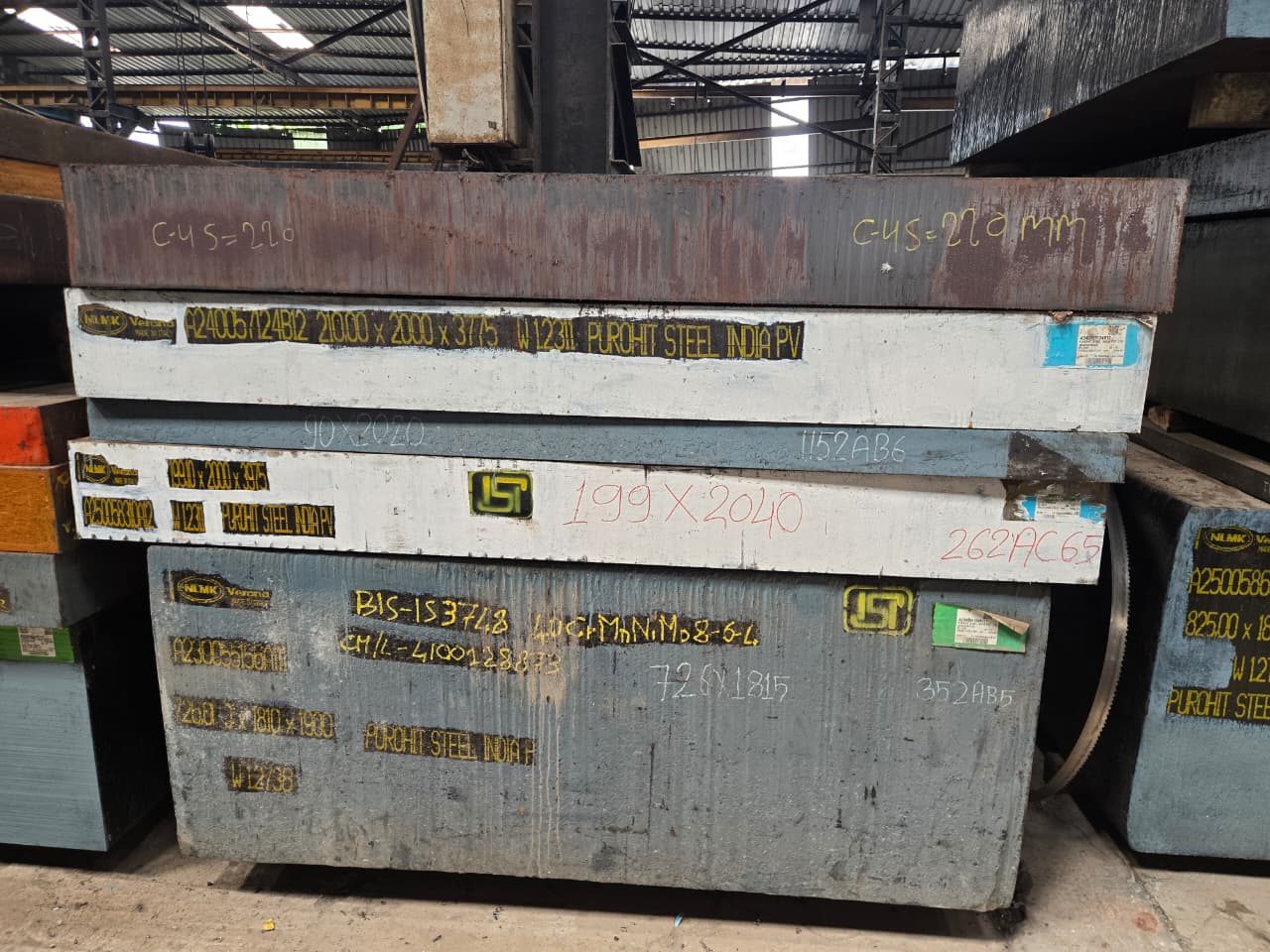
Why Purohit Steel for Grade 1.2738
- Ready Stock: Round bar, flat bar and block sizes held in inventory for immediate dispatch, including large sections
- ISO-Certified Quality: Documented quality management since 1965
- Authorized Stockist: Sourced through globally reputed manufacturers, including NLMK Verona and SeAH CSS
- Value-Added Machining: In-house bandsaw cutting, precision machining, grinding, drilling, gun drilling, EDM and wire-cut
- Technical Support: Assistance with grade selection, heat treatment guidance and equivalence mapping
- Pan-India & Export Supply: Warehousing in Vasai with a sales outlet in Mumbai, serving customers across India and international markets
- Export-Ready Packaging: Palletised, moisture-protected packing suitable for both domestic transport and export shipment
Comparison: 1.2738 vs 1.2311 vs 1.2083 ESR
Buyers often need to choose between related plastic mould steel grades. The table below compares 1.2738 against two other grades Purohit Steel stocks, to help select the right material for the application.
| Factor | 1.2738 (P20+Ni) | 1.2311 (P20) | 1.2083 ESR |
|---|---|---|---|
| Key alloying difference | Cr-Mn-Mo + Nickel | Base Cr-Mn-Mo | High-Chromium (~13%) stainless-type |
| Supply hardness | 300-340 HB | 280-325 HB | 290-330 HB |
| Hardenability through-section | Excellent, ideal for large blocks | Good up to medium sections | Good, moderate sections |
| Corrosion resistance | Low | Low | High |
| Best suited for | Large mould blocks needing uniform core hardness | Small to medium moulds, general tooling | Moulds for corrosive plastics, humid/food/medical environments |
| Relative cost | Medium | Lowest | Highest |
Grade 1.2738 Chemical Composition
Composition as per DIN EN ISO 4957 / DIN 17350 (typical mill range, weight %):
| Element | Symbol | Composition (%) |
|---|---|---|
| Carbon | C | 0.35 - 0.45 |
| Silicon | Si | 0.20 - 0.40 |
| Manganese | Mn | 1.30 - 1.60 |
| Chromium | Cr | 1.80 - 2.10 |
| Molybdenum | Mo | 0.15 - 0.25 |
| Nickel | Ni | 0.90 - 1.20 |
| Phosphorus | P | 0.030 max |
| Sulphur | S | 0.030 max |
| Iron | Fe | Balance |
The 0.90-1.20% nickel addition is the key difference from 1.2311 (P20) — it is what gives 1.2738 its deeper, more uniform through-hardenability.
Mechanical Properties of Grade 1.2738
Typical values in the as-supplied, pre-hardened (quenched & tempered) condition:
| Property | Typical Value |
|---|---|
| Hardness (supply condition) | 300 - 340 HB (approx. 32 - 37 HRC) |
| Tensile Strength (Rm) | 950 - 1150 MPa |
| Yield Strength (Rp0.2) | 700 - 870 MPa |
| Elongation at Break (A5) | 10 - 14% |
| Reduction of Area (Z) | 30 - 40% |
| Impact Toughness (Charpy V, longitudinal) | 20 - 28 J |
| Modulus of Elasticity (E) | ~212 GPa |
| Nitrided Surface Hardness | Up to 55 - 60 HRC |
Values are typical for material supplied in the standard pre-hardened condition and can vary with section size and mill batch. Mill test certificates (EN 10204 2.2 / 3.1) are available on request.
Physical & Thermal Properties
| Property | Value |
|---|---|
| Density | 7.85 g/cm³ |
| Thermal Conductivity (room temp.) | ~33 W/(m·K) |
| Coefficient of Thermal Expansion (20°C) | ~12.0 × 10⁻⁶ /K |
| Specific Heat Capacity | ~460 J/(kg·K) |
| Electrical Resistivity (room temp.) | ~0.47 µΩ·m |
Equivalent International Grades
| Country / Standard | Designation |
|---|---|
| Germany (Werkstoffnummer, DIN EN ISO 4957) | 1.2738 / 40CrMnNiMo8-6-4 |
| USA (Common trade designation) | P20+Ni / P20 Modified |
| China (GB/T 1299) | 3Cr2MnNiMo (closest equivalent) |
| Base grade without nickel (Germany) | 1.2311 (P20) |
Unlike 1.2311, 1.2738 does not have a single, separately standardized AISI/UNS code — it is traded internationally as P20+Ni or P20 Modified, built on the P20 (1.2311) family with added nickel for deeper hardenability. Refer to the comparison table above before substituting grades.
Heat Treatment Guidelines
| Process | Guideline |
|---|---|
| Supply condition | Quenched & tempered (pre-hardened) 300-340 HB — ready to machine, no further heat treatment normally required |
| Stress relieving (after heavy machining) | 550-600°C, hold approx. 2 hrs, furnace or air cool |
| Softening / annealing (if re-machining softer stock is required) | Heat to 700-730°C, cool slowly in furnace (≤20°C/hr) to 600°C, then air cool — yields approx. 235 HB max |
| Hardening (if higher hardness is required) | Preheat ~650°C, austenitize at 830-860°C, hold 20-30 min, quench in oil |
| Tempering | Double temper at 550-660°C per target hardness, 2 hrs each cycle, air cool between tempers |
| Nitriding (optional, for wear surfaces) | Gas or plasma nitriding to approx. 55-60 HRC surface hardness with a tough core |
Available Forms & Sizes
- Round Bars
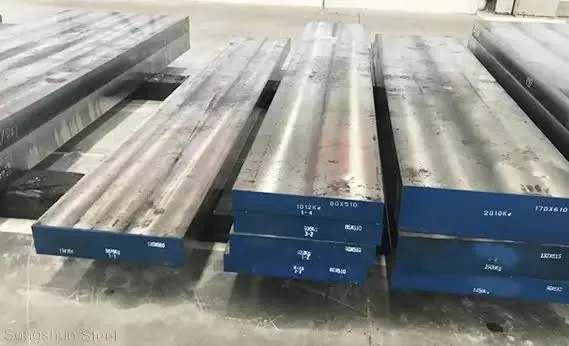
- Flat Bars / Plates
- Blocks, including large mould-base sections
- Custom sizes cut to drawing via in-house bandsaw cutting
Material is machined, ground, drilled and finished in-house through our precision machining, grinding, drilling, gun drilling, EDM and wire-cut facilities, so blocks can be supplied close to finished dimensions.
Machining & Selection Notes
- Cutting tools: At 300-340 HB, 1.2738 machines well with coated carbide tooling at moderate cutting speeds; excessive speed and heat build-up can locally temper the pre-hardened surface, so adequate coolant is recommended.
- Large blocks: Because through-hardness is more uniform than 1.2311, cavity and core inserts cut from the same block show less hardness variation, which helps consistency during polishing and texturing.
- Cavity work: Rough and semi-finish deep cavities before final finishing passes to reduce distortion from residual stress release.
- Welding / repair: 1.2738 has limited weldability; where weld repair is unavoidable, preheat to 150-200°C and stress-relieve after welding to reduce cracking risk.
- EDM finishing: The pre-hardened condition is well suited to EDM cavity sinking without further heat-treatment concerns.
- Grade selection: Choose 1.2738 for large mould blocks needing deep, uniform hardenability; step down to 1.2311 for smaller moulds with moderate production runs, or move to 1.2083 ESR where corrosion resistance is essential — see the comparison table above.
Applications of Grade 1.2738 Steel
1.2738 steel is widely used in large-format plastic mould manufacturing across India and export markets. Its deep, uniform hardenability makes it the preferred upgrade over base P20 wherever mould sections are thick or production volumes are high.
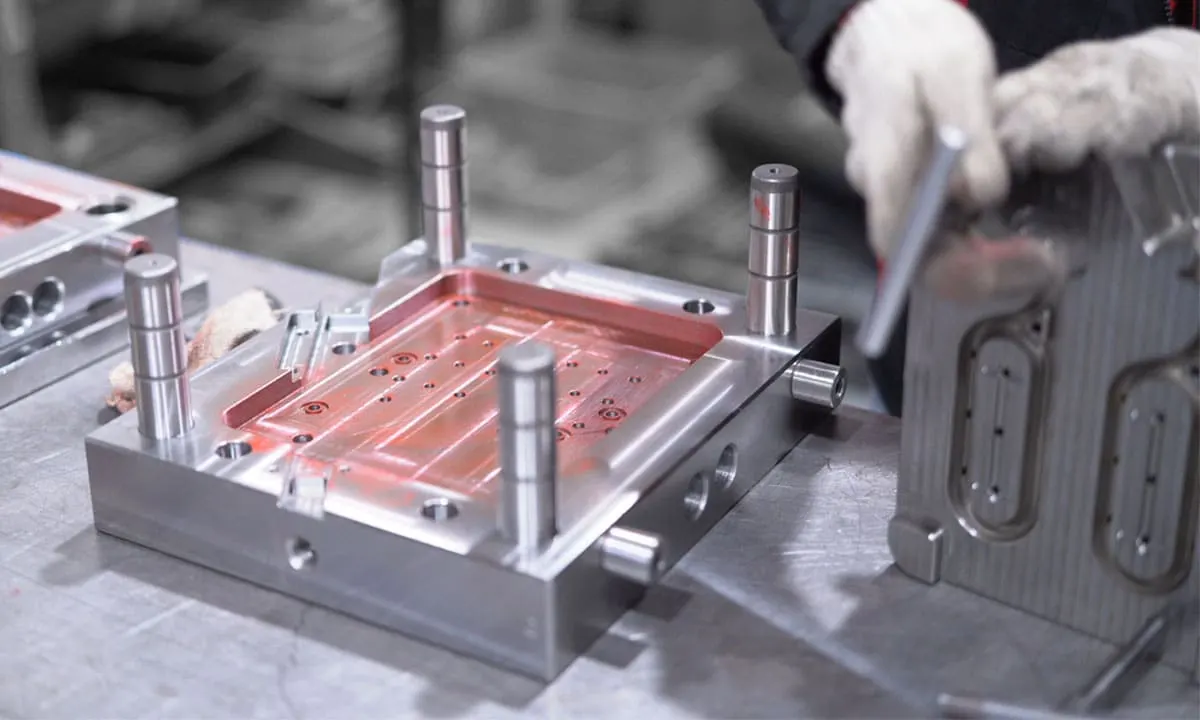
- Large plastic injection moulds
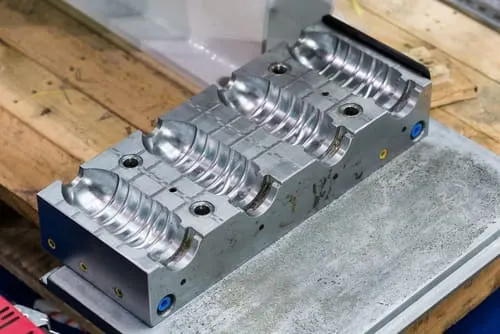
- Blow moulds
- Large mould base plates and holder blocks
- Automotive interior and exterior component moulds
- Low-pressure die-casting dies
- Household and consumer product moulds requiring high-quality finish
- Cavity and core inserts for high-volume production tooling
- General heavy tooling components
Grade 1.2738 for Large Mould Blocks
In large mould manufacturing, 1.2738 is preferred over 1.2311 where core and surface hardness must remain consistent through thick sections, ensuring predictable machining, polishing and long-term dimensional stability.
Automotive Industry
1.2738 is used for large dashboards, bumper, and structural interior/exterior trim moulds where uniform hardness and surface finish are critical across a big cavity.
Industries We Serve
- Automotive industry
- Plastic injection moulding industry
- Packaging manufacturing
- Consumer goods production
- Electrical component manufacturing
- Engineering & tooling workshops
Authorized Stockist



Grade 1.2738 Supply Locations Across India
We supply Grade 1.2738 steel across major industrial cities including Mumbai, Pune, Khopoli, Nashik, Aurangabad, Navi Mumbai, Palghar, Umbergaon, Vapi, Valsad, Daman, Vadodara, Ahmedabad, Rajkot, Hyderabad, Bangalore, Chennai, Cochin, Delhi, Gurgaon, Manesar and Sonipat — as well as to export markets.
Our Steel Products
Our Services
Frequently Asked Questions
About Purohit Steel
Purohit Steel was established in 1965 by Shree Bherumalji Rajpurohit, a visionary in metallurgy. Over the decades, we have built a strong reputation as a trusted stockist and exporter of tool steel, plastic mould steel and engineering steel products across India.
As an ISO-certified company, we source premium materials from globally reputed manufacturers and operate a modern warehousing facility in Vasai along with a sales outlet in Mumbai, enabling efficient storage, fast processing and timely delivery across India and export markets.
With decades of relationships with tool & die manufacturers and a customer-focused approach, Purohit Steel continues to deliver reliable, technically supported steel solutions for the mould-making industry.
Read more about Purohit Steel, view our certifications, or get in touch with our technical sales team.
Our Certifications
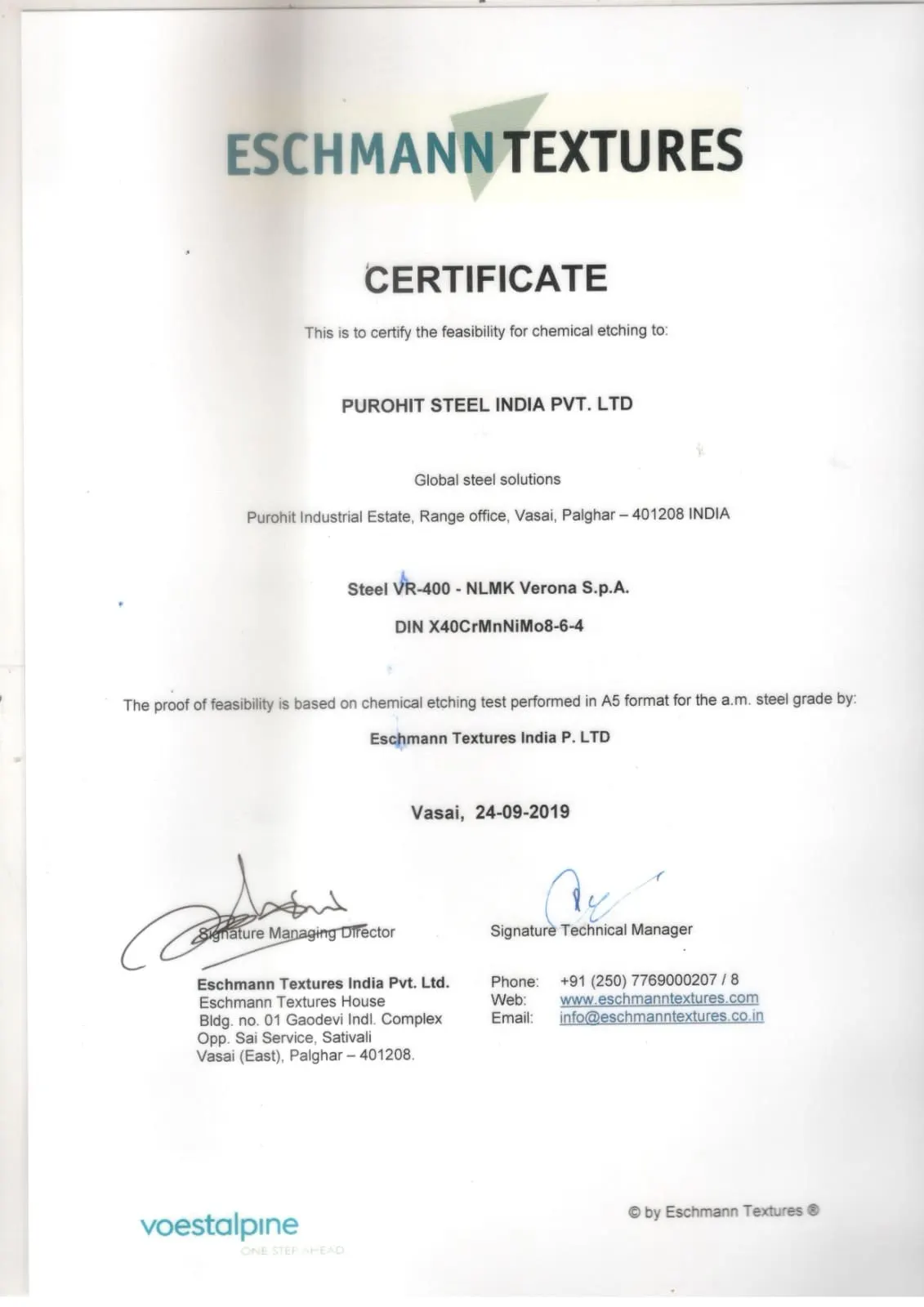
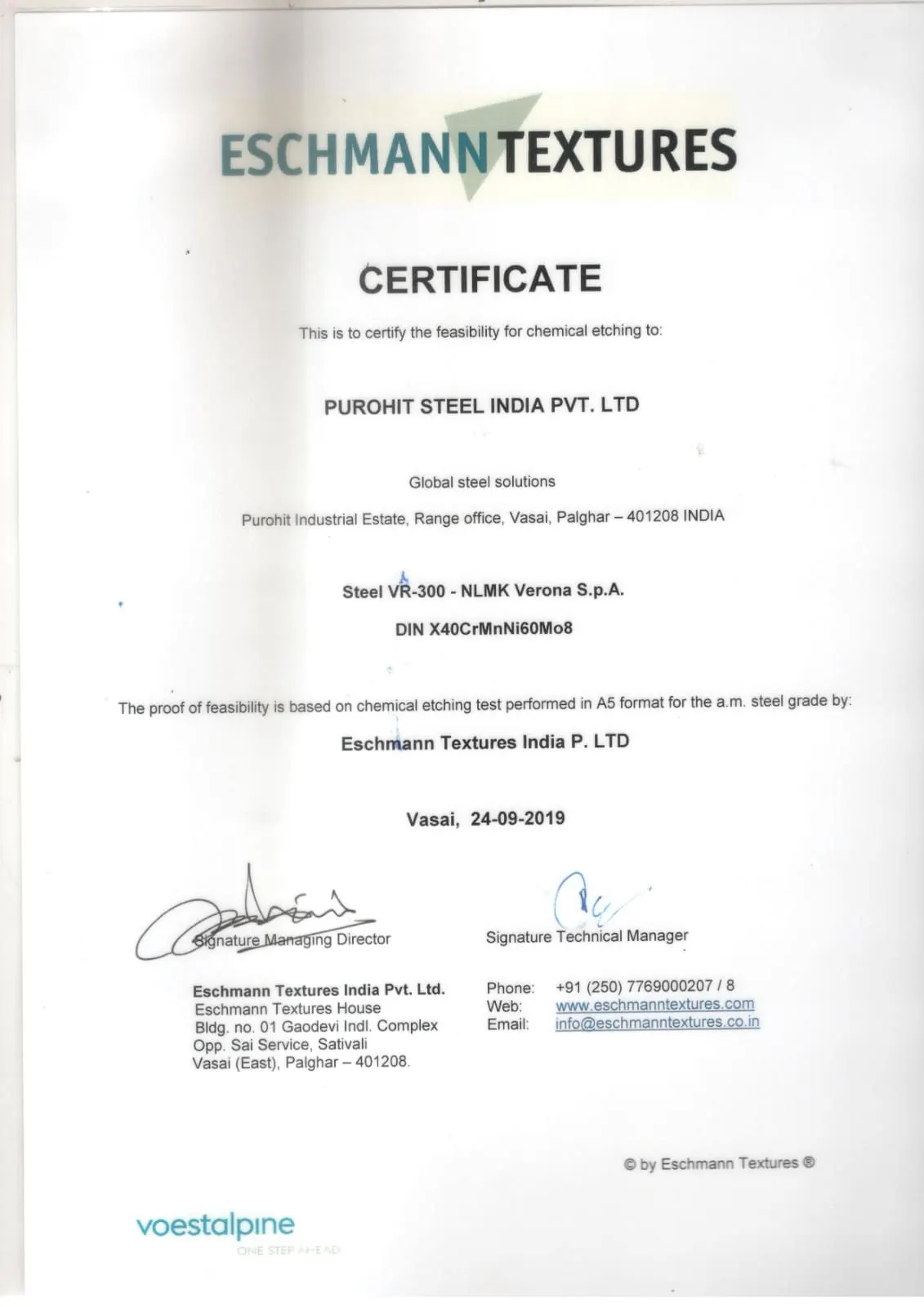
Purohit Steel operates as an ISO-certified company, backed by documented quality management, safety and compliance certifications that support reliable supply to domestic and export customers.
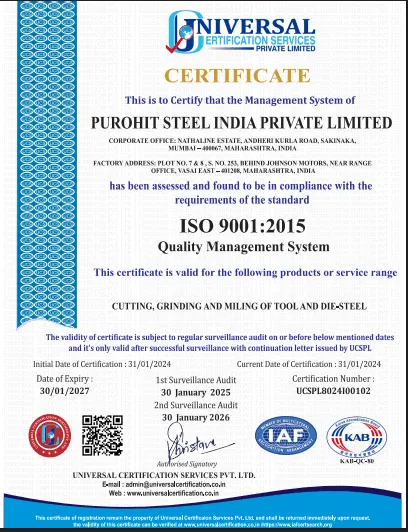
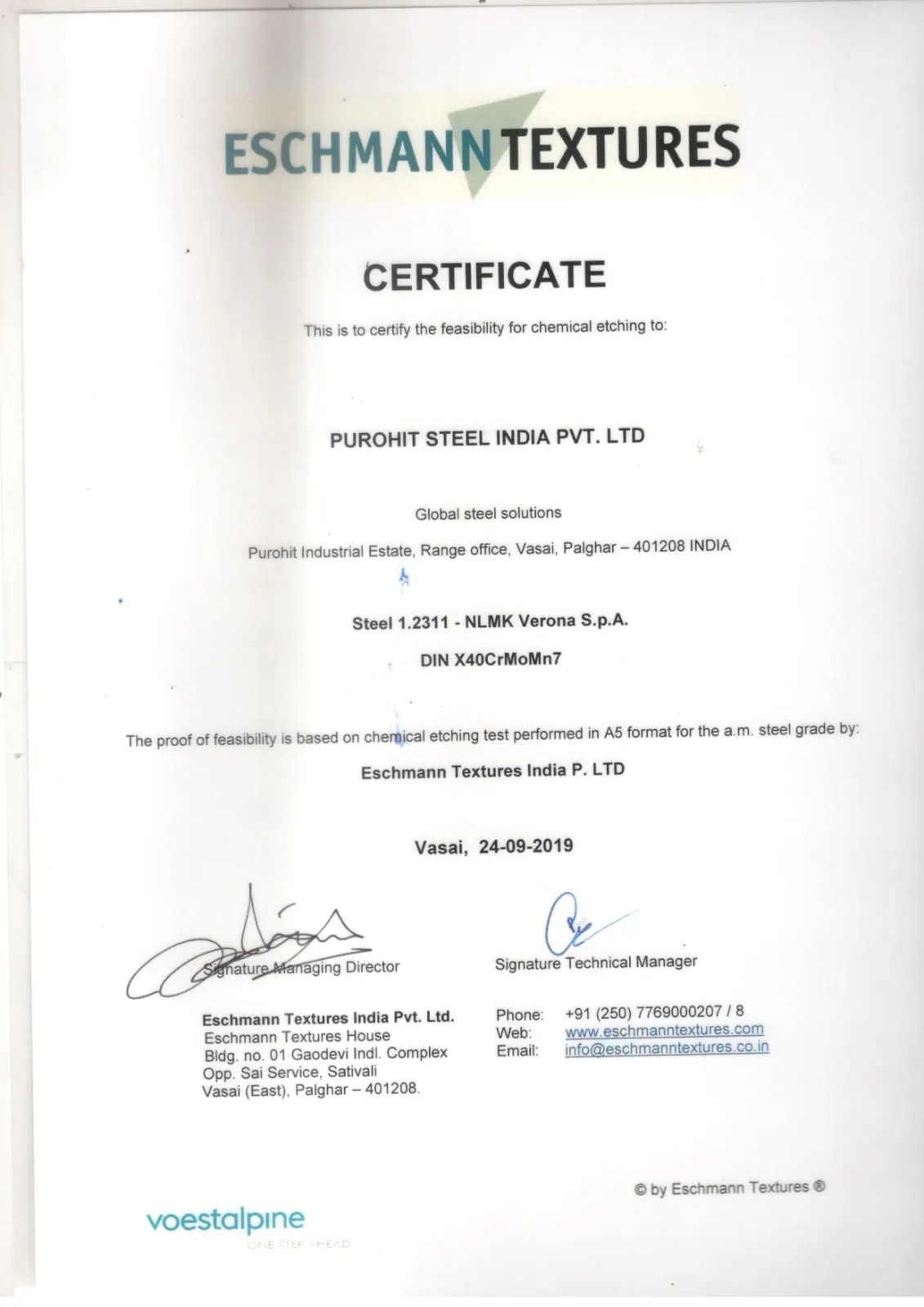
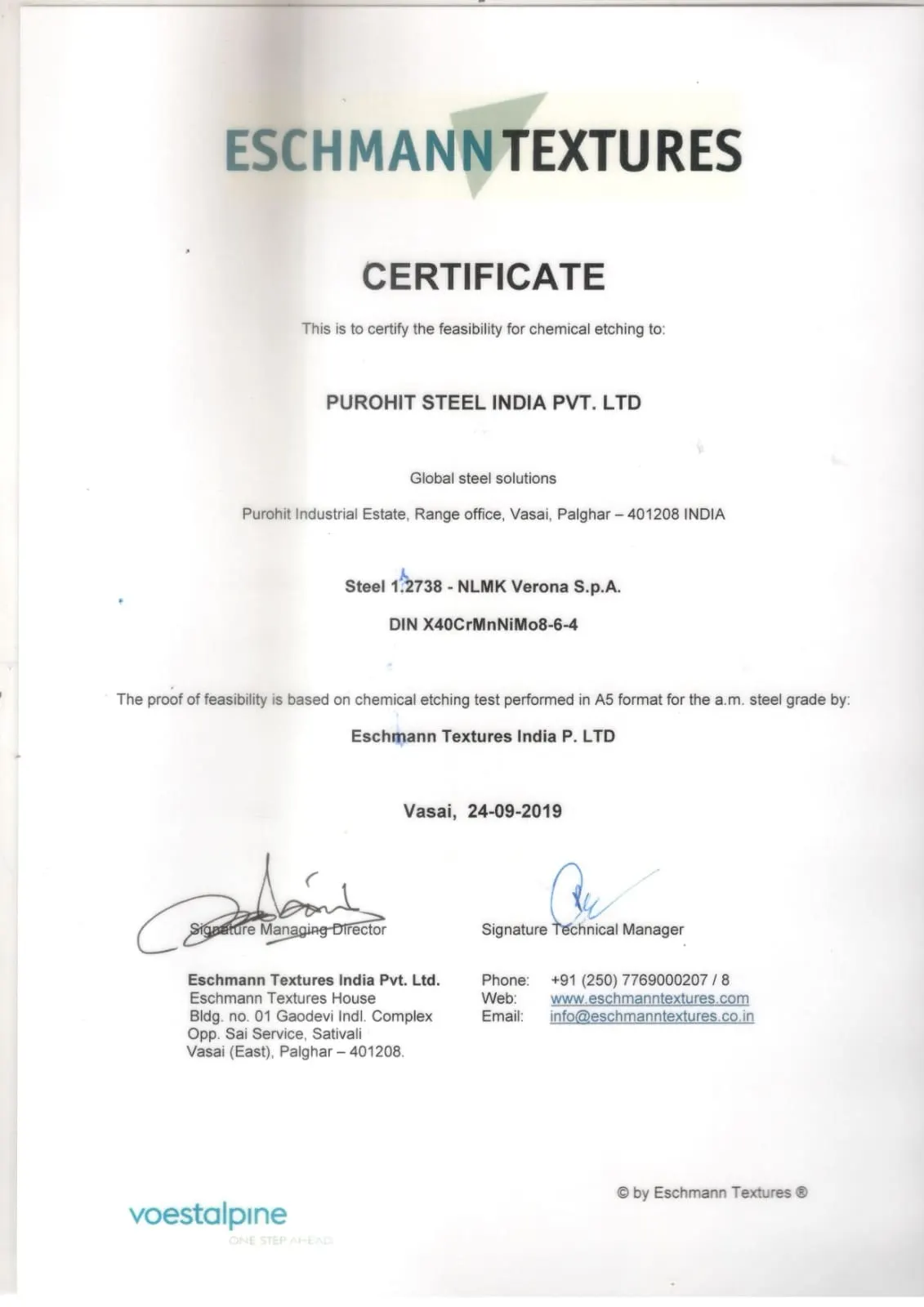
View all certificates in detail on our Certifications page.
Countries We Export Worldwide
Beyond India, Purohit Steel exports tool & mould steel grades to customers across the following countries and regions:
| Export Destinations | |||||
|---|---|---|---|---|---|
| UAE | Saudi Arabia | Oman | Bangladesh | Sri Lanka | Nepal |
| Vietnam | Thailand | Indonesia | Kenya | Nigeria | South Africa |
For export enquiries and destination-specific documentation, please contact our sales team.
Export Packaging & Shipping
Bars, flats and blocks are packed to withstand handling, transit and marine shipment, whether for domestic dispatch or export orders.
- Palletised and strapped packing for round bars, flat bars and blocks
- Moisture-protected wrapping to prevent surface corrosion in transit
- Seaworthy export packing with clear shipping marks and material identification
- Documentation support including packing lists, invoices and mill test certificates for customs clearance
- Shipment by road, rail or sea freight as per order requirement and destination
Quality Inspection & Testing
Every batch held in our stock is checked through documented inspection procedures before dispatch, so mould makers and OEMs receive material with verified, traceable quality.
- Chemical composition verification against mill certificates
- Hardness testing (Brinell / Rockwell) on received stock
- Dimensional inspection as per standard bar and block tolerances
- Visual and surface defect inspection
- EN 10204 2.2 / 3.1 mill test certificates provided on request
- Third-party inspection coordination available for export orders
Full material traceability is maintained from incoming stock through to dispatch for every order.
Latest Price List
Pricing depends on section size, quantity, form (round bar / flat bar / block) and current raw material rates. Indicative guidance is below — contact us for a firm, up-to-date quotation.
| Form | Typical Price Basis |
|---|---|
| Round Bar | Per Kg, based on diameter & length — contact for latest rate |
| Flat Bar / Plate | Per Kg, based on thickness & size — contact for latest rate |
| Block (cut to size) | Per Kg / Per Piece, based on drawing — contact for latest rate |
Prices are subject to change with raw material and freight costs. Share your required size and quantity via the quotation form or WhatsApp for the latest price.
MOQ & Payment Terms
Minimum Order Quantity: Flexible MOQ depending on size and form — from small trial quantities for tooling houses up to bulk orders for OEMs, subject to confirmation at enquiry stage.
Payment Terms: Advance payment / part-advance with balance before dispatch for domestic orders; T/T (bank transfer) or Letter of Credit (LC) for export orders, depending on order value and destination.